
What is Asian Time? Understanding Time Zones Across Asia
When it comes to time, Asia is a vast and diverse continent, stretching from the easternmost points of Japan to the western borders of Turkey. With such a wide expanse, it’s no surprise that Asia encompasses several time zones. In this article, we will explore Asian time and how the different time zones affect everything from business to travel, as well as how daylight saving time plays a role.
The Basics of Time Zones in Asia
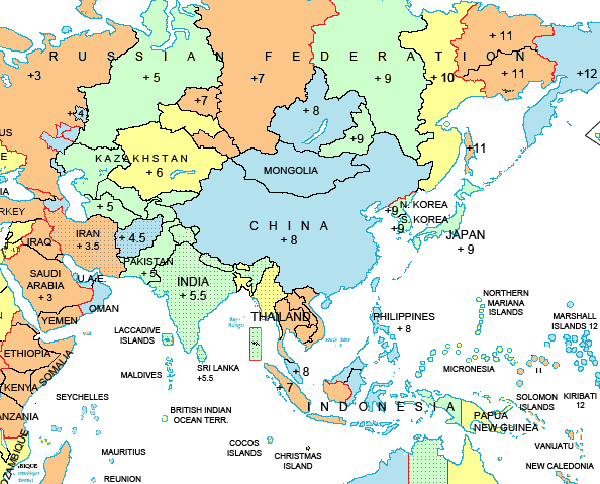
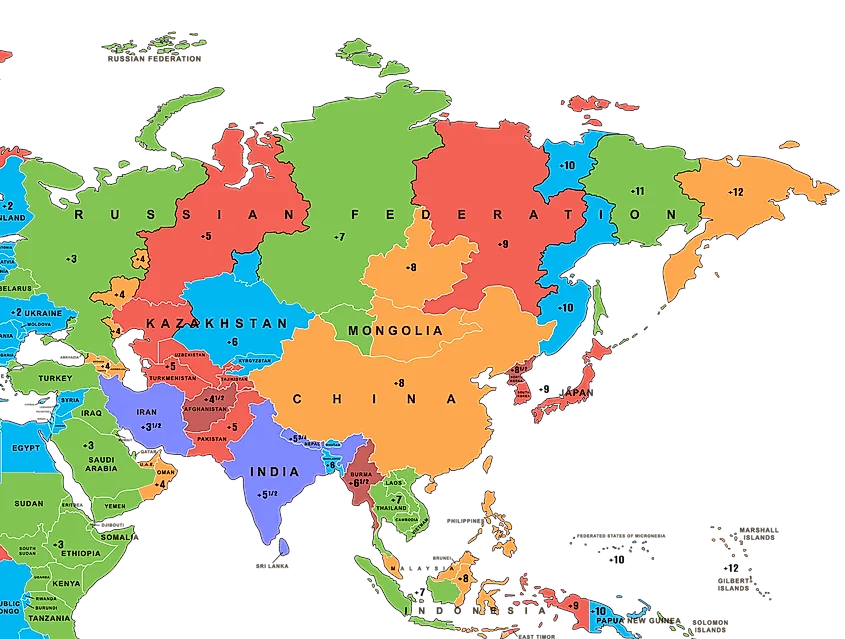
Asia spans over 12 hours of time difference from its easternmost to its westernmost borders. This huge geographical spread means that the continent is divided into several time zones, ranging from UTC+2 to UTC+12. These time zones are used by countries across Asia for daily activities, business operations, and travel schedules.
Key Time Zones in Asia
Here are some of the major time zones in Asia:
- UTC+2: Used by parts of Israel and Jordan.
- UTC+3: This is the time zone for Saudi Arabia, Kuwait, and Bahrain.
- UTC+5: Used by Pakistan and Uzbekistan.
- UTC+5:30: The time zone for India and Sri Lanka.
- UTC+6: Used by Bangladesh and Kazakhstan.
- UTC+7: Includes countries like Thailand, Vietnam, and Cambodia.
- UTC+8: The standard time zone for China, Singapore, and Malaysia.
- UTC+9: Used by Japan, South Korea, and North Korea.
- UTC+10: This time zone is used by Australia’s eastern territories, and parts of Papua New Guinea.
- UTC+12: Used by parts of Russia in Kamchatka and the Marshall Islands.
Time Zones in Asia and Their Impact on Business
Due to the time zone differences across Asia, businesses often face challenges in coordinating operations and meetings across borders. For example, companies based in India (UTC+5:30) may need to plan conference calls with partners in Japan (UTC+9), requiring careful planning to accommodate the time difference.
Globalization and Business Coordination
The rapid expansion of technology and the rise of global business have made it easier to overcome time zone challenges. Companies now rely on video conferencing tools, instant messaging, and scheduling software to work around the clock. The rise of remote work and virtual meetings has allowed businesses to operate across multiple time zones seamlessly.
Working Hours and the Cultural Shift
Different time zones also mean that the workday in one country may be entirely different from another. For instance, the standard workday in China often starts earlier than that of neighboring countries like India or Japan. Adjusting to these shifts is crucial for companies looking to maintain efficient communication and operational success in the region.
Daylight Saving Time in Asia
Unlike many parts of Europe and North America, Asia generally does not observe Daylight Saving Time (DST). This means that most countries in Asia do not adjust their clocks forward in the spring or backward in the fall, which can lead to confusion when interacting with countries that do observe DST.
However, there are exceptions. For example, Israel and Iran do observe daylight saving time, causing them to shift to a different time zone during the summer months.
Why is Asia So Diverse in Time Zones?
Geographical Spread and Longitude
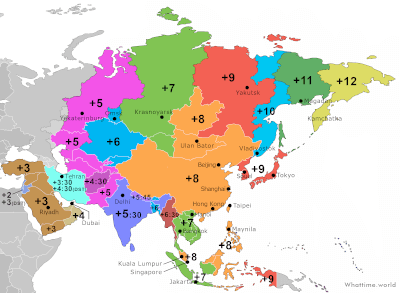
Asia’s time zone diversity is largely due to its vast geographic size. The continent stretches across numerous longitudes, and this creates a wide range of times from east to west. From Japan’s UTC+9 to Turkey’s UTC+3, the difference is significant, affecting everything from local daily schedules to international diplomacy.
Political Factors
Another reason for the time zone spread in Asia is the political choices made by different countries. For example, China, despite spanning multiple time zones, officially uses a single time zone, UTC+8. This is mainly due to the central government’s desire to maintain uniformity across the country. On the other hand, India has a single time zone, UTC+5:30, despite being geographically positioned to span two.
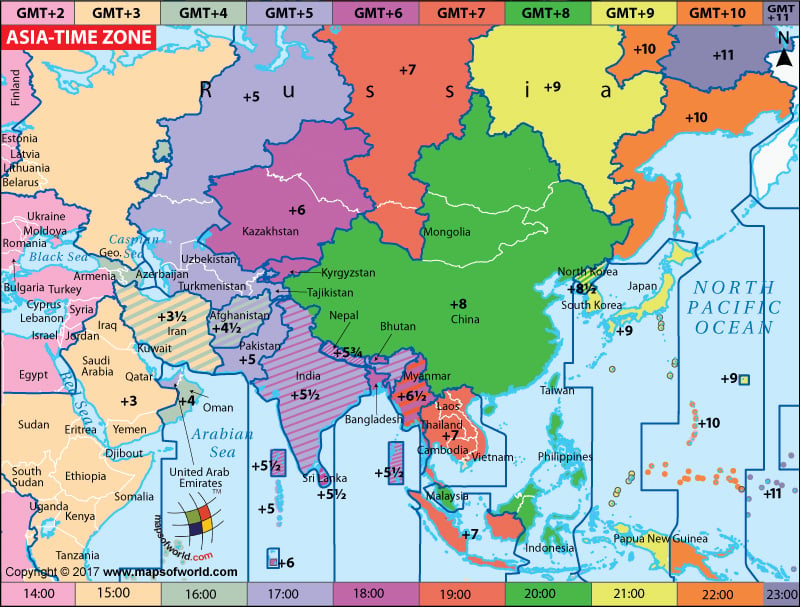
Time Zone Map of Asia
Understanding Asia’s time zones can be a bit tricky, but the Asia Time Zone Map below shows the regions with their corresponding time differences.
Common Questions About Asian Time Zones
1. Why do some Asian countries have a different time zone even though they are geographically close?
Geopolitical decisions and national preferences often influence the time zones of a country. For example, India uses UTC+5:30 despite being geographically aligned with other countries that use UTC+6. Similarly, China uses a single time zone (UTC+8) even though the country spans multiple time zones.
2. Do any Asian countries use Daylight Saving Time?
Yes, some countries like Israel and Iran observe Daylight Saving Time (DST), shifting their clocks forward in the summer months. However, the majority of countries in Asia do not follow this practice.
3. How do time differences affect travel within Asia?
Time differences can complicate travel, especially when flying across several countries with varying time zones. Travelers need to adjust their schedules accordingly to accommodate flights, check-in times, and layovers, which may span different time zones.
4. Can time zones affect international business in Asia?
Yes, time zones can impact business operations, especially for companies operating across multiple countries. Scheduling meetings, coordinating projects, and handling time-sensitive tasks often require detailed planning. Global time zone converters are valuable tools to avoid scheduling conflicts.
Conclusion: Navigating the Complex Time Zones of Asia
Asia’s time zones can be challenging to navigate, but understanding how they work is essential for anyone doing business, traveling, or communicating across borders. Whether you’re working with partners in China, India, or Japan, staying mindful of the differences in time zones can help ensure smoother communication and more efficient planning.
Time differences are just one of the factors that make Asia a unique and complex region to navigate. With the right tools and knowledge, anyone can manage the time challenges and make the most of the vast opportunities the continent has to offer.
Comment (0)